
Literary Institute Researchers Score a Hat-Trick: Three Literary Studies Published in Keel ja Kirjandus
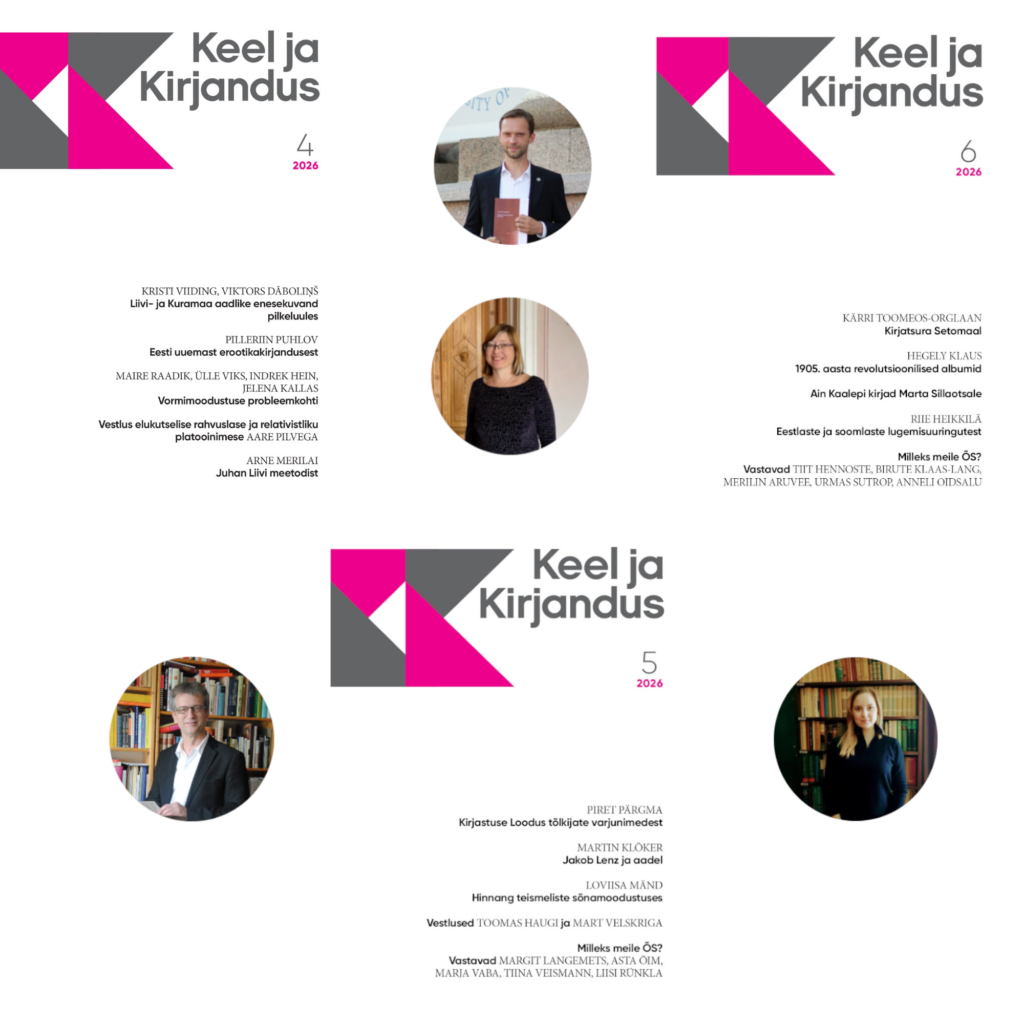
Researchers at the Under and Tuglas Literary Institute have made history by publishing articles in three consecutive issues of the journal Keel ja Kirjandus. The studies are united by their focus on overlooked literary works and their exploration from fresh perspectives, helping to fill gaps in our understanding of both aristocratic and working-class literary cultures.
Kristi Viiding, Viktors Dāboliņš Liivi- ja Kuramaa aadlike kirjanduslik enesekuvand XVII sajandi pilkeluules (The identity of Livonian and Courlandian nobility in 17th-century satirical poetry, Keel ja Kirjandus 4/2026)
The article examines the formation of the identity of 17th-century Livonian and Courlandian nobility as reflected in their predominantly unpublished satirical poems – verse satires, witty epigrams, and sonnets – during the reign of various rulers (Poland, Sweden, and Denmark) and amid internal conflicts between the local hereditary elites and new nobility. The study aims to diachronically analyze which characteristics of the nobility are ridiculed and criticized in satirical poems, and how the tools of humanist and Baroque poetry – contrast, allegory, imagery, personification, comparison, etc. – were employed for the self-defence, self-representation, and self-justification of the Livonian and Courland nobility within their actual political circumstances. Read the full article here.
Martin Klöker Jakob Lenz, aadel ja balti kirjanduslik aadlimaastik (Jakob Lenz, the nobility, and the Baltic literary landscape of nobility, Keel ja Kirjandus 5/2026)
The nobility has played a central role in Baltic literature since the 18th century, and even more so in the 19th and 20th centuries. On the one hand, there is a disproportionately high number of aristocratic authors – especially women. On the other hand, the nobility is portrayed in literature in a wide variety of ways: as individuals and social groups, as landowners and rulers of peasants, and as enlightened or unenlightened. This article explores how Jakob Lenz (1751–1792) and his works contribute to this tradition. His works clearly demonstrate a broader literary and critical interest in the nobility and its social world, as evidenced, for example, by the character of the Hofmeister, through whom, according to Guthke, Lenz depicts the aristocratic milieu as “almost caricatured to the point of the bizarre”. However, the question arises as to how such literary portrayal relates to Lenz’s own life and, more specifically, to his personal experiences in Livonia. Read the full article here.
Hegely Klaus 1905. aasta revolutsioonikirjanduse kaks näidet: „Wõitluse päiwil“ ja „Edasi. Tööliste jõulualbum“ (Two examples of revolutionary literature from 1905: “In Times of Struggle” and “Forward: Workers’ Christmas Album”, Keel ja Kirjandus 6/2026)
This article compares two literary albums published amid the upheavals of the 1905 Revolution: “In Times of Struggle” (Wõitluse päiwil), issued by the Young Estonia (Noor-Eesti) movement, and “Forward: Workers’ Christmas Album” (Edasi. Tööliste jõulualbum), a collection compiled by working-class authors. The study examines the ways in which subjectivity and voice are employed to articulate revolutionary ideas. Alongside struggle and resistance, Estonian revolutionary literature at the turn of the 20th century was also marked by an ambivalence between individual and collective self-definition. How do these two albums reflect the era’s impulse towards transformation through personal and social experience, and through processes of self-definition? The textual analysis focuses on poetic and narrative techniques, contrasting the workers’ literature’s rejection of formal constraints and emphasis on storytelling with Young Estonia’s rejection of convention and experimentation with literary form. Read the full article here.
Keel ja Kirjandus (Language and Literature) is a monthly journal of the Estonian Academy of Sciences and Estonian Writers’ Union, published since 1958. A year’s worth of issues spans approximately 1000 pages on linguistics, literature, folklore, and cultural history. As a primary source of philological information for students at all levels, Keel ja Kirjandus is an essential read for scholars of Estonian philology and history. Undergraduates will find it both a welcome extension of their lecture notes and a platform for discussion. In addition to original scholarly articles the journal features essays, reviews, and updates from the world of philology.