When a Book Steps Beyond Its Covers – Kerttu Siplane’s Exhibition at the Literary Institute Museum
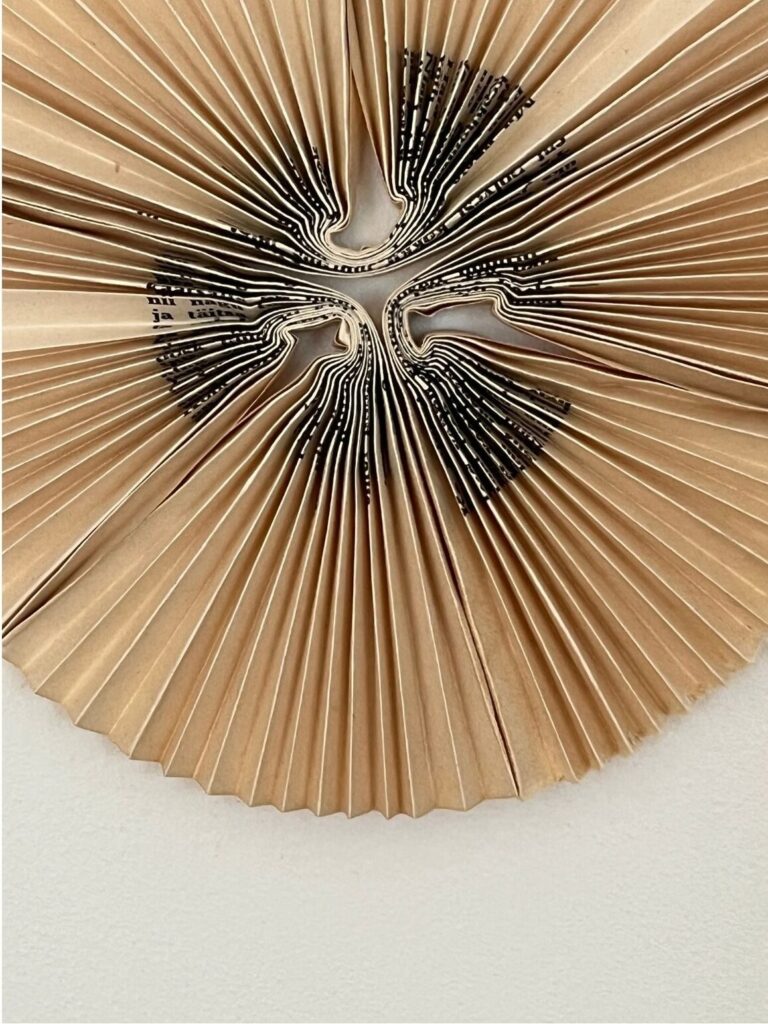
From Monday, 2 March, visitors to the Literary Institute Museum can explore the exhibition „Out from Between the Covers“ by fashion designer Kerttu Siplane.
The exhibition emerged from a place where books have lost their original function but found a new meaning through their material presence. Thousands of pages from dust-covered books, rescued from the reuse shelves of recycling centres, have been transformed into creative material through which layers of time, emotion, and memory are revealed. The objects—varying in form, texture, and tonal nuance—have come into being through journeys guided by chance and curiosity, shaped through the collaboration of hand and material by folding, cutting, gluing, casting, and moulding. They are combined with natural materials such as cotton thread and handmade glue, following the principle that the works should either be compostable or recyclable as material once again—temporary in their nature, yet timeless in the questions they raise.
The artist describes the exhibition as follows:
„Worlds forgotten beneath a layer of dust, their edges yellowed by the sun; carelessly stacked side by side, in rows and piles, in boxes and on bookshelves, waiting in a recycling centre’s reuse room. They evoke mixed emotions and awaken admonishing voices from childhood: „You must take care of books! Books are valuable! Don’t scribble in books! Wash your hands before touching a book! Be careful! Turn the pages more slowly! Don’t fold the corners!“ And so on. Yet here they all are now—these books that have lost their value, status, and place on the shelf. Worn by the passage of time, to a greater or lesser extent, both in content and in form. Placed into boxes and brought here in the hope that someone might still need them. Want them. Dust them off. Open the cover. Take them home.“